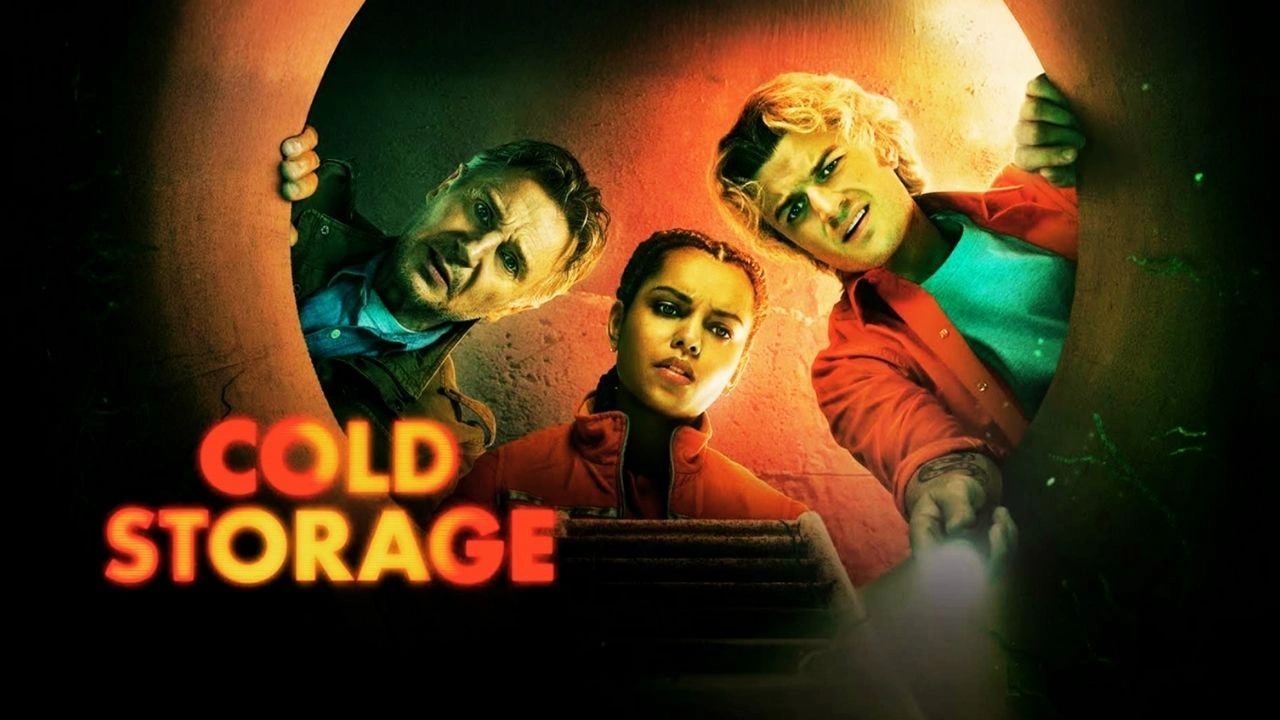
Cold Storage Movie is a genre-blending cinematic experiment that dares to fuse comedy, horror, and science fiction into a single, fast-moving narrative about human error, biological terror, and reluctant heroism. Directed by Jonny Campbell and written by veteran screenwriter David Koepp, the film adapts a high-concept premise into a surprisingly character-driven story. Anchored by performances from Liam Neeson, Joe Keery, and Georgina Campbell, Cold Storage explores what happens when an invisible threat escapes human containment—and when ordinary people are forced to confront extraordinary danger.
Set for release on February 20, 2026, in the United Kingdom, the film positions itself as both a popcorn thriller and a cautionary tale. Beneath its sharp humor and nerve-wracking suspense lies a deeper commentary on institutional secrecy, scientific hubris, and the fragile illusion of control.
A High-Concept Premise with Timely Resonance
At its core, Cold Storage revolves around a highly dangerous fungus that escapes from a clandestine laboratory. Unlike conventional cinematic monsters, this threat has no face, no voice, and no moral compass. It grows silently, adapts rapidly, and kills efficiently. The invisibility of the antagonist immediately sets the film apart, forcing the tension to arise not from jump scares alone but from anticipation and paranoia.
The story gains momentum when a former bioterrorism agent, long removed from the field, is pulled back into action. Tasked with containing a threat that may already be beyond control, he is joined—somewhat improbably—by two young employees who happen to be in the wrong place at the wrong time. This unlikely trio becomes the emotional and narrative backbone of the film.

What makes the premise particularly compelling is its grounded plausibility. In an age shaped by pandemics, bioengineering debates, and mistrust of secretive institutions, Cold Storage feels unsettlingly relevant. The film does not rely on far-fetched science but instead leans into the idea that the most dangerous threats are often the ones humanity creates itself.
View Also: Spirit Movie Review 2026: A Brutal, Unfiltered Cop Drama That Redefines Moral Boundaries
Direction: Jonny Campbell’s Balancing Act
Jonny Campbell faces a daunting task: balancing comedy, horror, and science fiction without letting any single genre overpower the others. His direction demonstrates a keen understanding of tonal control. The humor never undercuts the danger, and the horror never becomes so bleak that it smothers the film’s playful energy.
Campbell’s approach is refreshingly restrained. Rather than overwhelming the audience with nonstop spectacle, he allows tension to build organically. Long corridors, sealed doors, and malfunctioning climate controls become sources of dread. The director uses space and silence effectively, creating an atmosphere where the unseen threat feels omnipresent.
What stands out most is Campbell’s focus on character reactions. The fear in Cold Storage is often communicated not through visual effects but through faces—eyes widening, breaths quickening, bodies freezing in place. This emphasis on human response grounds the film emotionally, making the horror feel personal rather than abstract.
Writing and Screenplay: David Koepp’s Genre Expertise
David Koepp, known for his work on some of Hollywood’s most iconic thrillers and science fiction films, brings his seasoned craftsmanship to Cold Storage. The screenplay is tight, efficient, and sharply paced, with dialogue that serves both character development and narrative propulsion.
Koepp excels at introducing complex ideas without bogging down the story. Scientific concepts are explained just enough to be credible, but never so much that they disrupt the momentum. The fungus is terrifying precisely because it is not over-explained; its unpredictability keeps both characters and audience on edge.
The script also shines in its character dynamics. The generational gap between the seasoned bioterrorism agent and the younger employees provides fertile ground for humor and conflict. Their differing perspectives on authority, risk, and responsibility add layers to what could have been a straightforward survival story.
Importantly, the screenplay avoids the trap of excessive exposition. Instead, information is revealed through action and consequence, allowing viewers to piece together the scope of the disaster alongside the characters.
Performances: Liam Neeson’s Quiet Authority
Liam Neeson brings a weathered gravitas to the role of the former bioterrorism agent. This is not the relentless action hero of his earlier thrillers, but a man burdened by experience and haunted by past failures. Neeson plays him with restraint, conveying authority through subtle gestures rather than bombast.
His performance anchors the film, providing a sense of seriousness that grounds the more comedic elements. When Neeson’s character speaks, the film listens—and so does the audience. His presence lends credibility to the stakes, reminding viewers that this is not merely a quirky genre mashup but a story with real consequences.
Joe Keery, best known for his charismatic charm, delivers a performance that balances humor with genuine vulnerability. His character serves as an audience surrogate, reacting with disbelief and nervous wit to the unfolding catastrophe. Keery’s timing ensures that the comedy feels natural rather than forced.
Georgina Campbell adds emotional depth and resilience to the trio. Her character is resourceful, intelligent, and unwilling to be sidelined. Campbell’s performance avoids clichés, presenting a young woman who grows into leadership under pressure without losing her humanity.
Character Dynamics: An Unlikely Team Against an Unseen Enemy
One of Cold Storage’s greatest strengths lies in the chemistry between its central characters. The film thrives on the tension and trust that develop among individuals thrown together by circumstance rather than choice.
The former agent represents institutional knowledge and caution. The younger employees embody adaptability, skepticism, and modern problem-solving. Their interactions highlight generational contrasts in how danger is perceived and managed. This dynamic not only provides humor but also underscores a thematic question: who is best equipped to handle crises in a rapidly changing world?
As the threat escalates, these relationships deepen. Moments of conflict give way to mutual respect, and the film takes time to show how shared adversity can forge unexpected bonds. This emotional investment ensures that the audience cares not just about whether the fungus is contained, but about whether the characters survive the ordeal intact.
Horror Without a Face: The Power of the Invisible Threat
Unlike traditional horror films that rely on monstrous designs, Cold Storage builds its terror around what cannot be seen. The fungus operates silently, spreading through air systems and surfaces, turning everyday environments into death traps.
This invisibility amplifies the suspense. Characters—and viewers—are constantly questioning whether a room is safe, whether a breath is fatal, whether it is already too late. The film cleverly uses environmental cues—frost forming, alarms blaring, systems failing—to signal danger without revealing it outright.
Horror is psychological as much as physical. Fear arises from uncertainty, from the inability to fight or even see the enemy. This approach makes the film’s tension more enduring, lingering long after individual scenes have ended.
Comedy as a Survival Mechanism
While Cold Storage is undeniably intense, its comedic elements serve an important function. Humor becomes a coping mechanism, a way for characters to maintain sanity in the face of overwhelming danger.
The comedy is situational rather than slapstick. It emerges naturally from character interactions, awkward timing, and the absurdity of facing extinction-level threats in mundane settings. Joe Keery’s performance, in particular, ensures that lighter moments never feel out of place.
This balance prevents the film from becoming oppressive. By allowing audiences to laugh, even briefly, Cold Storage enhances the impact of its darker moments. The contrast between humor and horror makes each more effective.
Science Fiction Elements: Plausibility Over Spectacle
As a science fiction film, Cold Storage favors plausibility over extravagance. The technology depicted is grounded in real-world research and speculation, lending the story a sense of authenticity.
The secret laboratory, climate-controlled environments, and containment protocols feel credible rather than fantastical. This realism strengthens the film’s cautionary message about the dangers of unchecked scientific ambition.
Rather than focusing on futuristic gadgets, the film emphasizes human error and institutional secrecy as the true catalysts of disaster. This choice reinforces the idea that technology itself is not inherently evil, but becomes dangerous when divorced from ethical responsibility.
Cinematography and Atmosphere
Visually, Cold Storage adopts a cold, sterile aesthetic that mirrors its thematic concerns. Blues, grays, and muted whites dominate the color palette, creating an atmosphere of isolation and unease.
The camera work is deliberate, often lingering on empty spaces or slowly tracking through corridors to build tension. Close-ups are used sparingly but effectively, drawing attention to moments of realization or fear.
Lighting plays a crucial role in shaping mood. Flickering fluorescents, emergency lighting, and shadowed corners contribute to a sense of instability. The film’s visual language reinforces the idea that safety is an illusion, constantly on the verge of collapse.
Pacing and Structure: A Relentless Descent
The pacing of Cold Storage is methodical yet relentless. The film begins with a slow burn, establishing characters and environment before gradually escalating the stakes. Once the fungus escapes, the narrative rarely pauses, propelling viewers from one crisis to the next.
This structure mirrors the nature of the threat itself—once unleashed, it cannot be easily stopped. The escalating tension keeps audiences engaged, while brief moments of calm allow for character development and reflection.
Some viewers may find the intensity exhausting, but this seems intentional. The film wants its audience to feel trapped, pressured, and uncertain, mirroring the characters’ experience.
Themes: Control, Responsibility, and Human Hubris
Beneath its genre thrills, Cold Storage Movie grapples with serious thematic questions. Who is responsible when scientific experimentation goes wrong? Can dangerous knowledge ever be truly contained? And how much should the public know about the risks taken in the name of progress?
The film critiques institutional secrecy, suggesting that the greatest danger lies not in the fungus itself but in the systems designed to hide and manage it. By placing ordinary people at the center of the crisis, the narrative emphasizes that the consequences of elite decisions are often borne by the unsuspecting many.
At the same time, the film acknowledges human resilience. Despite fear and uncertainty, the characters persist, adapt, and fight back—not through brute force, but through cooperation and ingenuity.
View Also: Parasakthi Movie Review 2026: A Fiery Chronicle of Language, Identity, and Resistance
Strengths and Minor Weaknesses
The strengths of Cold Storage Movie are numerous: strong performances, a tight screenplay, effective genre blending, and a timely premise. Its ability to balance humor and horror without undermining either is particularly impressive.
However, the film is not without flaws. Some secondary characters feel underdeveloped, serving more as narrative devices than fully realized individuals. Additionally, viewers seeking traditional monster horror may find the lack of a visible antagonist initially frustrating.
These minor issues, however, do little to detract from the film’s overall impact. The ambition and execution far outweigh any shortcomings.
Official Trailer – Cold Storage Movie
Conclusion: A Smart, Tense, and Entertaining Genre Hybrid
Cold Storage Movie stands out as a smart, suspenseful, and surprisingly thoughtful film that uses genre conventions to explore real-world anxieties. With confident direction from Jonny Campbell, a sharp script by David Koepp, and compelling performances led by Liam Neeson, the film delivers both thrills and substance.
It is a reminder that the most frightening monsters are often of our own making—and that survival sometimes depends on unlikely alliances. For fans of science fiction, horror, and dark comedy alike, Cold Storage offers a memorable cinematic experience that lingers long after the final scene.
As it approaches its 2026 release, Cold Storage positions itself not just as entertainment, but as a reflection of contemporary fears wrapped in gripping storytelling.
3 thoughts on “Cold Storage Movie Review: When Science Loses Control and Horror Finds a Sense of Humor”