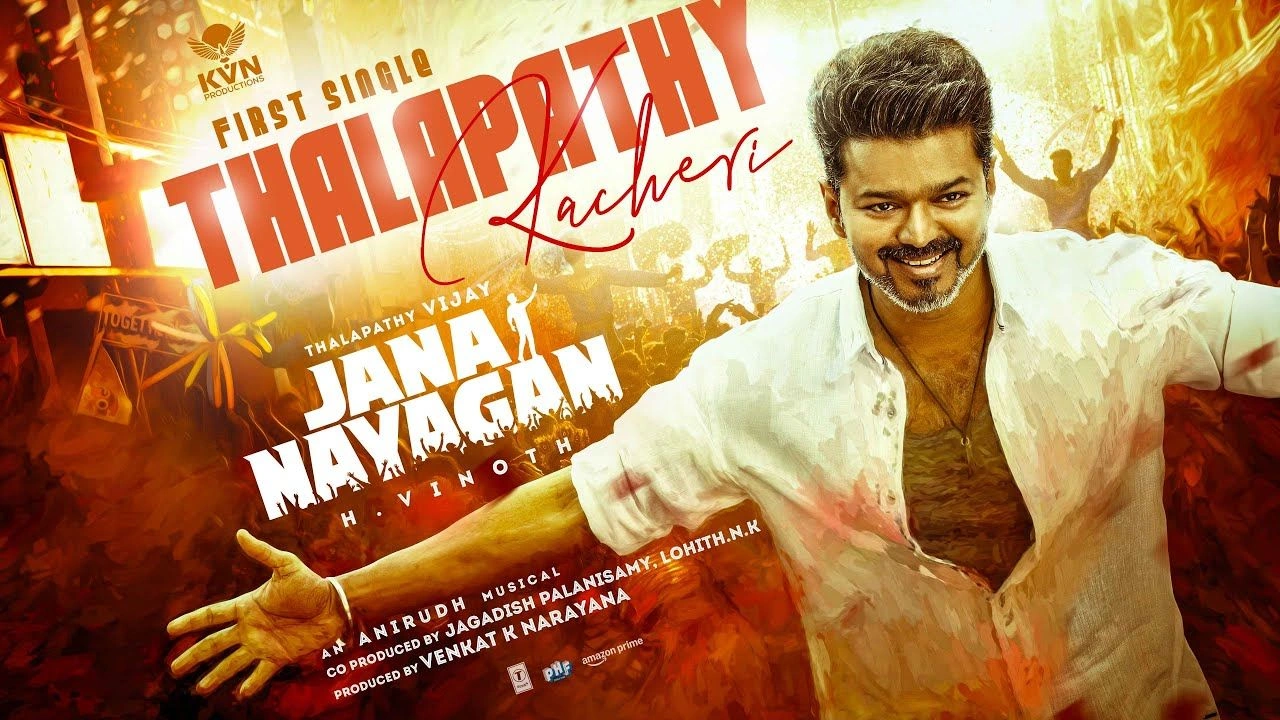
Jana Nayagan Movie: One man, one final stand, and a battle where justice, pride, and reconciliation collide for the last time.
Jana Nayagan (2026) emerges as one of the most talked-about Indian action thrillers of the year, not only because of its scale and intensity but also due to the emotional weight it carries. Directed and written by H. Vinoth, the film stars Joseph Vijay (Thalapathy Vijay) alongside Pooja Hegde and Bobby Deol in pivotal roles.
With the powerful tagline “One Last Time”, Jana Nayagan feels more than just another mass entertainer—it plays out like a statement film, blending action, emotion, and political undertones. The story revolves around a determined man seeking justice against a powerful businessman who ruined him financially, yet the narrative takes an unexpected turn by exploring conflict resolution, morality, and restraint, instead of blind revenge.
A Story That Balances Revenge and Resolution
At its heart, Jana Nayagan tells a deceptively simple story. Vijay plays a principled man whose life is derailed by a corrupt and influential businessman. Financial loss turns into personal humiliation, and what begins as a quest for justice soon becomes a battle of ego, power, and ideology.
However, the film refuses to stay confined to a typical revenge template. As the plot unfolds, it becomes clear that this is not just about retaliation, but about how far a man is willing to go to reclaim dignity—and whether violence is truly the only answer.
The brilliance of the screenplay lies in its restraint, allowing the conflict to escalate gradually while giving space for reflection, dialogue, and emotional depth.
H. Vinoth’s Direction: Controlled, Confident, and Purpose-Driven
H. Vinoth is known for crafting stories that merge action with strong ideological cores, and Jana Nayagan is no exception. His direction ensures that every major set piece carries narrative weight, not just spectacle.

What Stands Out in Vinoth’s Direction:
- Clear moral positioning without being preachy
- Tight screenplay that avoids unnecessary subplots
- Strong focus on consequences rather than glorification
- Intelligent dialogues that drive conflict
Vinoth treats action as a tool, not the destination, ensuring the story remains grounded even during its most explosive moments.
Thalapathy Vijay: Authority, Calm, and Controlled Fire
Thalapathy Vijay delivers a performance that feels measured, mature, and deeply intentional. Unlike his flamboyant, larger-than-life avatars, Vijay here opts for controlled intensity. His character does not rush into violence; he calculates, observes, and chooses his battles carefully.
Highlights of Vijay’s Performance:
- Minimalistic body language with maximum impact
- Powerful dialogue delivery without shouting
- Emotional restraint that adds gravitas
- Commanding screen presence in confrontation scenes
This role feels like a reflection of Vijay’s evolution as an actor, presenting him as a man who understands power, responsibility, and restraint.
Bobby Deol: A Formidable and Convincing Antagonist
Bobby Deol plays the powerful businessman antagonist with cold confidence. His character is not loud or flashy—he is dangerous because of his influence, connections, and emotional detachment.
Instead of portraying a stereotypical villain, Bobby Deol brings subtle menace, making the conflict feel realistic and unsettling. His face-offs with Vijay are some of the film’s strongest moments, driven more by dialogue and silence than physical violence.
The clash between these two characters is ideological as much as it is personal.
Pooja Hegde: Emotional Anchor of the Film
Pooja Hegde plays a crucial role that grounds the narrative emotionally. Rather than being a decorative presence, her character provides perspective, conscience, and emotional balance.
She represents:
- The cost of prolonged conflict on personal relationships
- The human side of a man consumed by justice
- A voice of reason without being submissive
Her performance is understated yet effective, adding emotional depth to the story without distracting from the central conflict.
Screenplay & Dialogues: Sharp, Thoughtful, and Impactful
The dialogues in Jana Nayagan are one of its strongest assets. Instead of punchlines designed only for applause, the film opts for meaningful lines that reflect ideology, power dynamics, and morality.
Many dialogues feel written to linger in the audience’s mind, especially those addressing:
- Power versus accountability
- Wealth-driven injustice
- The difference between revenge and justice
These lines elevate the film beyond a standard action thriller.
Action Sequences: Purposeful and Grounded
Action in Jana Nayagan is intense but never excessive. Every fight scene exists to move the story forward rather than showcase unnecessary brutality.
Action Highlights:
- Realistic hand-to-hand combat
- Well-choreographed confrontations
- Minimal slow-motion usage
- Emotion-driven action rather than spectacle
The film consciously avoids glorifying violence, reinforcing the idea that true strength lies in control, not chaos.
Music & Background Score: Emotion Over Noise
The background score complements the film’s tone with restraint. Instead of overpowering scenes, the music enhances emotional beats and heightens tension during confrontations.
Key moments are allowed to breathe in silence, making dialogues and expressions more impactful. The score understands when to step back, which is rare in action-heavy films.
Cinematography & Visual Aesthetics
Visually, Jana Nayagan maintains a grounded, realistic look. The colour palette leans toward earthy and muted tones, reflecting the seriousness of the narrative.
Visual Strengths:
- Clean framing during dialogue-heavy scenes
- Dynamic camera movement during action sequences
- Effective use of lighting to convey mood and power
The visuals support the story without drawing attention away from performances.
Themes That Give Jana Nayagan Its Identity
Beyond action and thrills, the film explores several compelling themes:
- Justice versus vengeance
- Power and accountability
- The possibility of resolution without destruction
- Personal dignity in the face of loss
These themes give Jana Nayagan emotional and intellectual weight, making it resonate with a wider audience.
Strengths of Jana Nayagan
- Mature and controlled performance by Vijay
- Strong antagonist in Bobby Deol
- Purpose-driven direction by H. Vinoth
- Meaningful dialogues with social relevance
- Balanced mix of action and emotion
View Also: Ikkis Movie Review 2026: Cast, Story, Verdict & Analysis
Minor Limitations
- Slow pacing in parts may not appeal to fans expecting nonstop action
- Limited scope for side characters
- Heavy dialogue-driven scenes may feel intense for casual viewers
However, these are narrative choices that support the film’s vision rather than weaken it.
Cultural & Fan Impact
With Vijay’s massive fanbase and the film’s thoughtful messaging, Jana Nayagan is expected to spark conversations beyond cinema halls. The tagline “One Last Time” adds emotional significance, making the film feel like a landmark moment in Vijay’s career.
This is not just a film—it is an experience designed to be remembered.
Official Trailer
Conclusion: Is Jana Nayagan Worth Watching?
Absolutely.
Jana Nayagan (2026) stands as a powerful, mature, and emotionally charged action thriller that prioritises meaning over noise. With a commanding performance by Thalapathy Vijay, a strong antagonist, and H. Vinoth’s disciplined storytelling, the film delivers a compelling cinematic experience.
For viewers seeking intelligent action, strong performances, and a story rooted in justice rather than chaos, Jana Nayagan is a must-watch.
3 thoughts on “Jana Nayagan Movie Review (2026): Thalapathy Vijay’s Explosive Stand in a Power-Packed Action Thriller”