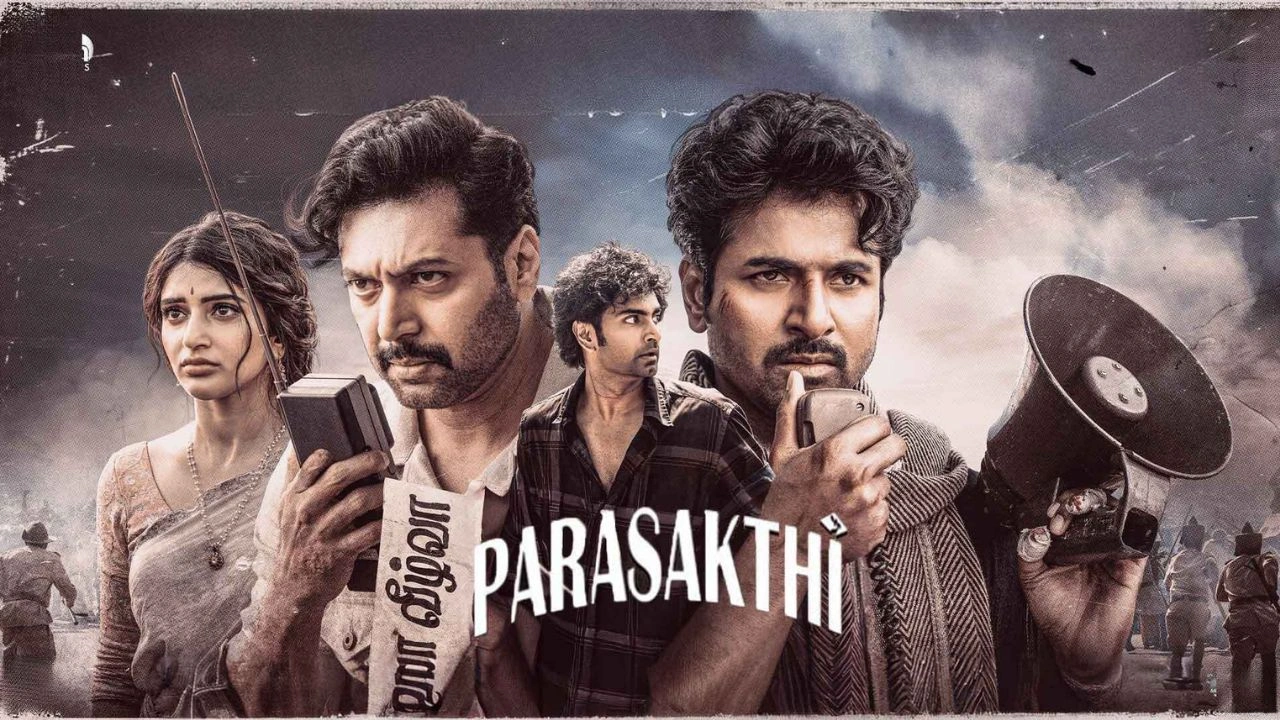
Parasakthi Movie: A searing historical drama revisits Tamil Nadu’s linguistic resistance through stirring performances, political courage, and cinematic ambition.
In Parasakthi Movie, director Sudha Kongara returns with an ambitious, emotionally charged historical drama that confronts one of the most defining sociopolitical movements in South India: the Anti-Hindi Imposition agitations of 1965 in Tamil Nadu. Inspired by true events, the film blends action, drama, and history to craft a narrative that is both deeply personal and politically resonant. Featuring powerful performances by Sivakarthikeyan, Atharvaa Murali, and Sreeleela, Parasakthi is not merely a film—it is a statement about identity, resistance, and the enduring power of language.
Set against a turbulent chapter in India’s post-independence history, Parasakthi arrives as a timely reminder of how cultural conflicts shape collective memory. With its release scheduled for January 10, 2026, in France, the film signals an intent to bring a regional yet universal story to a global audience, underscoring the international relevance of local struggles.
Historical Context: Revisiting the 1965 Anti-Hindi Agitations
At the heart of Parasakthi lies the Anti-Hindi Imposition movement, a mass uprising that erupted in Tamil Nadu in 1965 when the Indian government attempted to enforce Hindi as the sole official language. For many Tamils, this move was perceived as a threat to their linguistic heritage and cultural autonomy. The protests, led largely by students and political activists, escalated into statewide demonstrations that left an indelible mark on Indian federal politics.

The film does not treat this backdrop as a mere history lesson. Instead, it immerses viewers in the emotional intensity of the era, capturing the fear, anger, and hope that fueled the resistance. Sudha Kongara’s direction ensures that historical details are woven seamlessly into the narrative, allowing audiences unfamiliar with the events to grasp their gravity without feeling overwhelmed.
By grounding the story in real incidents, Parasakthi achieves a rare balance: it honors historical truth while crafting a cinematic experience that feels urgent and alive.
View Also: Border 2 Movie Review: A Powerful War Epic Reigniting the Spirit of 1971
Direction and Vision: Sudha Kongara’s Political Storytelling
Sudha Kongara has built a reputation for films that combine social realism with strong emotional arcs, and Parasakthi may be her most politically assertive work to date. Her direction is confident, deliberate, and unafraid to confront uncomfortable truths. Rather than romanticizing the past, she presents it with all its contradictions—idealism clashing with state power, youthful fervor confronting systemic authority.
What sets Kongara apart here is her human-centered approach. The political movement is seen through the eyes of individuals whose lives are irrevocably altered by the struggle. This perspective prevents the film from becoming didactic, instead fostering empathy and reflection.
Visually, Kongara opts for grounded realism. The camera lingers on crowded streets, protest marches, and intimate domestic spaces, reinforcing the idea that history is shaped as much in homes and classrooms as it is in government halls. Her control over tone ensures that moments of action never overshadow the underlying emotional stakes.
Writing and Screenplay: A Chorus of Voices
Written by Ganeshaa, Madhan Karky, and Shan Karuppusamy, the screenplay of Parasakthi is one of its strongest assets. The trio brings together poetic dialogue, political clarity, and character-driven storytelling. Each writer’s sensibility is evident, yet the script feels cohesive and purposeful.
The dialogues, in particular, stand out for their restraint and impact. Rather than relying on grand speeches alone, the film often uses quiet conversations to convey ideological conflict. A single line spoken in a classroom or at a dinner table can carry the weight of an entire movement.
Madhan Karky’s lyrical touch elevates key moments, while Shan Karuppusamy’s grounded realism anchors the narrative. Ganeshaa’s contribution lies in structuring the story so that it flows organically between personal drama and collective action. Together, they craft a screenplay that respects its audience’s intelligence and emotional depth.
Performances: Sivakarthikeyan’s Career-Defining Role
Sivakarthikeyan delivers what can confidently be called a career-defining performance in Parasakthi. Known largely for his charm and comedic timing, he undergoes a striking transformation here, embodying a young man radicalized not by ideology alone but by lived injustice. His portrayal captures the vulnerability of someone torn between personal aspirations and political responsibility.
Atharvaa Murali complements this with a performance that is equally intense but more restrained. His character serves as a counterpoint, representing the internal conflicts within the movement itself. The chemistry between Sivakarthikeyan and Atharvaa adds emotional complexity, highlighting how solidarity can coexist with disagreement.
Sreeleela, in a role that avoids tokenism, brings warmth and resilience to the narrative. Her character provides an emotional anchor, reminding viewers that political upheaval often exacts its heaviest toll on personal relationships. Her performance adds a crucial human dimension to an otherwise tumultuous storyline.
Genre Fusion: Action, Drama, and History in Harmony
Parasakthi operates at the intersection of action, drama, and history, a challenging blend that few films manage successfully. The action sequences are not gratuitous; they arise naturally from protest clashes, police confrontations, and moments of chaos. These scenes are shot with urgency, placing viewers amid the turmoil rather than offering spectacle for its own sake.
The dramatic elements are rooted in character arcs—friendships tested, families divided, ideals questioned. Meanwhile, the historical framework lends weight and significance to every choice made by the characters. This genre fusion ensures that the film appeals to a wide audience while maintaining thematic integrity.
What truly distinguishes Parasakthi is its refusal to simplify history into heroes and villains. Instead, it presents a complex moral landscape, acknowledging the costs of resistance alongside its necessity.
Music, Sound, and Emotional Resonance
Though details of the music composer remain under wraps, the film’s sound design and musical cues play a vital role in shaping its emotional impact. The score is used sparingly, allowing silence and ambient noise to speak volumes during critical moments.
Traditional Tamil musical motifs subtly underscore scenes of cultural pride, while more somber compositions accompany moments of loss and disillusionment. The result is a soundscape that enhances rather than overwhelms the narrative.
Chants, slogans, and street sounds are integrated authentically, reinforcing the sense of being present within a living, breathing movement. The auditory experience of Parasakthi deepens its emotional resonance, making the struggle feel immediate and personal.
Cinematography and Production Design: Recreating a Turbulent Era
The cinematography captures the spirit of 1960s Tamil Nadu with meticulous attention to detail. Muted color palettes reflect the seriousness of the times, while occasional bursts of color—flags, posters, crowds—symbolize resistance and hope.
Production design deserves special mention for its authenticity. From period-accurate costumes to carefully recreated urban and rural settings, every frame feels lived-in. This commitment to realism strengthens the film’s credibility and immerses viewers fully in its world.
Camera movements are purposeful, often handheld during protest scenes to convey instability and tension. In contrast, static shots dominate quieter moments, emphasizing introspection and emotional gravity. The visual language of Parasakthi mirrors its thematic depth, reinforcing the story without distraction.
Language as Identity: The Core Theme of Parasakthi
At its core, Parasakthi is a meditation on language as identity. The film argues that language is not merely a tool for communication but a vessel of history, culture, and self-respect. Through its characters, it explores how linguistic pride can become a catalyst for political awakening.
Rather than framing the conflict as anti-Hindi sentiment, the narrative emphasizes the right to linguistic plurality and federal respect. This nuanced approach prevents misinterpretation and invites broader conversations about diversity and inclusion.
In an era where cultural homogenization remains a global concern, Parasakthi resonates far beyond its regional setting. Its message—that preserving one’s language is an act of self-preservation—feels universally relevant.
Global Relevance and International Release
The decision to release Parasakthi internationally, beginning with France, signals confidence in the film’s global appeal. While deeply rooted in Tamil history, its themes of resistance, identity, and state power transcend borders.
International audiences may draw parallels with their own histories of cultural suppression and protest. The film thus serves as both a window into Indian political history and a mirror reflecting global struggles for recognition and autonomy.
This international positioning also highlights the growing influence of Indian regional cinema on the world stage. Parasakthi stands as evidence that powerful stories, when told with honesty and craft, can cross linguistic and cultural boundaries.
Strengths and Minor Shortcomings
Among the film’s many strengths are its performances, direction, and thematic clarity. The commitment to historical authenticity and emotional truth sets it apart from conventional political dramas.
However, some viewers may find the pacing uneven, particularly in the middle sections where the narrative delves deeply into ideological debates. While intellectually engaging, these moments may test the patience of audiences expecting continuous action.
Yet, these minor shortcomings do little to diminish the film’s overall impact. The ambition and sincerity of Parasakthi outweigh its imperfections, making it a significant cinematic achievement.
Official Trailer – Parasakthi Movie
Conclusion: A Bold and Necessary Film
Parasakthi is not just a movie; it is a cultural and political statement. By revisiting the Anti-Hindi Imposition agitations of 1965, it challenges audiences to reflect on the ongoing relevance of linguistic and cultural rights. With compelling performances, thoughtful writing, and assured direction, the film stands as one of the most important Indian historical dramas in recent years.
For viewers seeking cinema that engages both the heart and the mind, Parasakthi Movie offers a powerful, unforgettable experience. It reminds us that history is not confined to textbooks—it lives on through stories, voices, and the enduring fight for identity.
4 thoughts on “Parasakthi Movie Review 2026: A Fiery Chronicle of Language, Identity, and Resistance”