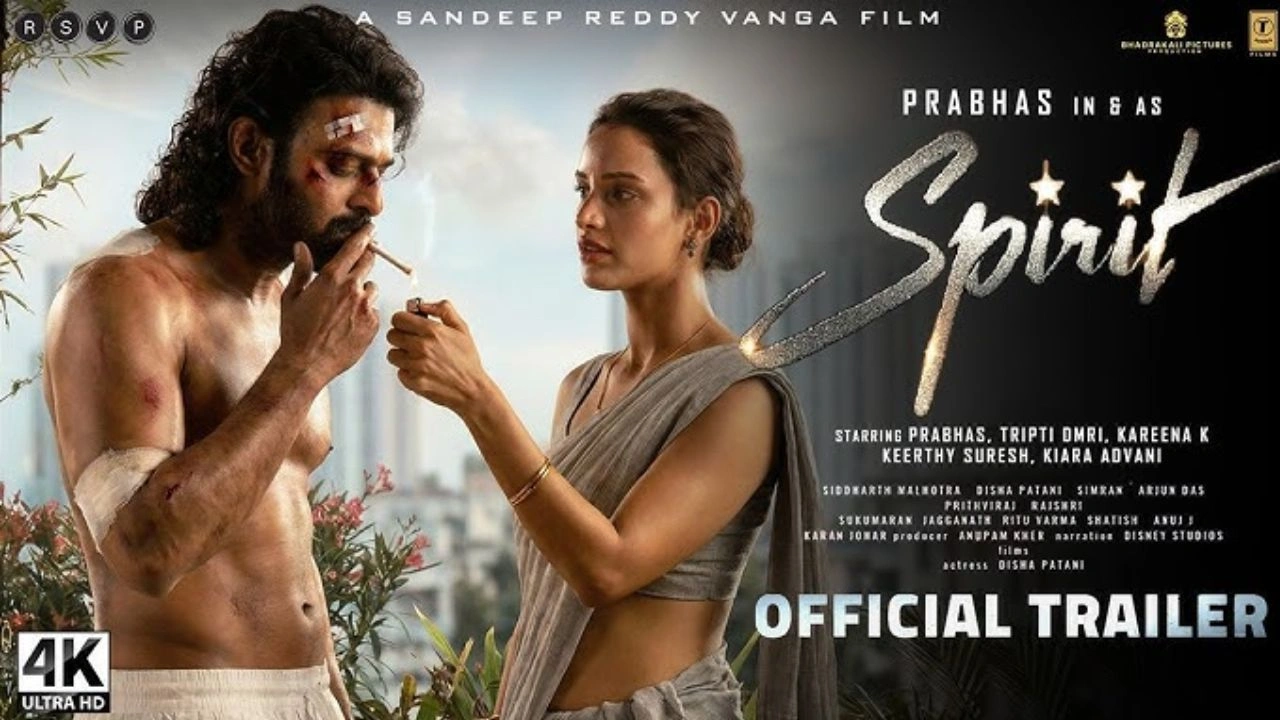
Spirit Movie: An uncompromising action drama exploring justice, rage, and redemption through the journey of a brutally honest police officer.
Spirit (2026) stands tall as one of the most intense and discussion-worthy Indian films of the decade. Written and directed by Sandeep Reddy Vanga, the film dives headfirst into the psyche of a cop who refuses to bend, break, or negotiate with crime. Known for his polarising yet deeply impactful storytelling, Vanga once again delivers a film that is raw, emotionally volatile, morally complex, and visually arresting.
Positioned as a pan-Indian action drama and released in Telugu, Hindi, Tamil, Malayalam, Kannada, and Chinese, Spirit is not designed to comfort the audience. Instead, it confronts them—forcing viewers to question what justice really means when the system itself is broken.
A Story Rooted in Rage, Truth, and Consequence
At its core, Spirit follows the journey of a police officer who is brutally honest to a fault. He does not sugarcoat the truth, does not compromise with corruption, and does not operate within the convenient grey areas that often define cinematic law enforcement. This uncompromising nature puts him at odds not just with criminals, but also with the system he serves.

The narrative unfolds as the protagonist embarks on a mission to dismantle a deeply entrenched criminal network. However, unlike conventional cop films, Spirit is less about “catching the bad guys” and more about the psychological and moral cost of doing so.
Every arrest leaves a scar. Every encounter chips away at the man behind the uniform.
Sandeep Reddy Vanga’s Signature Storytelling
Sandeep Reddy Vanga has built a reputation for crafting characters who are emotionally extreme, deeply flawed, and painfully human. With Spirit, he channels that intensity into the framework of a cop drama, creating a film that feels both familiar and disturbingly new.
What Sets His Direction Apart:
- Long, immersive scenes that allow emotions to breathe
- Minimal spoon-feeding of moral lessons
- Characters who are neither heroes nor villains, but something in between
- A fearless approach to violence, language, and emotional breakdown
Spirit does not attempt to justify its protagonist—it simply presents him. The audience is left to decide whether they admire him, fear him, or both.
View Also: Ikkis Movie Review 2026: Cast, Story, Verdict & Analysis
Character Study: The Cop as a Human Weapon
The unnamed central character is not portrayed as a traditional “protector of society.” He is a weapon forged by trauma, anger, and an unshakeable belief in truth. His honesty is not gentle; it is sharp, often cruel, and frequently self-destructive.
Layers of the Protagonist:
- A man driven by principle, not popularity
- A cop who sees the law as a tool, not a shield
- A human being slowly eroded by violence and isolation
What makes the character compelling is that he is fully aware of his own darkness. He understands the consequences of his actions but chooses to move forward anyway, believing that inaction is the greater crime.
Narrative Structure: Slow Burn Meets Explosive Impact
Unlike fast-paced commercial action films, Spirit follows a slow-burn narrative. The first half spends considerable time establishing the protagonist’s mindset, his strained relationships, and the corrupt ecosystem he operates within.
The second half escalates dramatically, both emotionally and physically. Violence becomes more frequent, confrontations more personal, and the psychological toll more visible.
The film does not rush to its climax—it earns it.
Action Sequences: Real, Relentless, and Uncomfortable
Action in Spirit is not choreographed for applause. It is ugly, chaotic, and exhausting, much like real violence.
Action Highlights:
- Brutal hand-to-hand combat with minimal background score
- Interrogation scenes that test ethical boundaries
- Gunfights that feel sudden and terrifying rather than stylish
There is no glorification of bloodshed. Instead, the film repeatedly reminds viewers that every act of violence leaves permanent damage—physically and mentally.
Emotional Depth: More Than Just a Cop Film
While marketed as an action drama, Spirit is deeply emotional at its core. The protagonist’s personal life—his loneliness, fractured relationships, and inability to connect with normalcy—forms the emotional backbone of the story.
The film explores:
- Emotional numbness caused by prolonged exposure to violence
- The isolation of being morally uncompromising
- The personal cost of choosing truth over comfort
These moments of silence and vulnerability are where Spirit truly shines.
Music & Background Score: Controlled, Minimal, Effective
The background score in Spirit is used with restraint. Instead of overpowering scenes, the music often fades into the background, allowing silence and ambient sound to dominate.
When the score does rise, it does so to underline internal conflict rather than external action. This subtle approach enhances the film’s realism and emotional weight.
Cinematography & Visual Tone
Visually, Spirit adopts a dark, gritty, and grounded aesthetic. The camera lingers on faces, wounds, and environments, capturing the decay of both the city and the man trying to cleanse it.
Visual Strengths:
- Muted colour palette reflecting moral ambiguity
- Handheld camera work during intense scenes for realism
- Close-ups that expose emotional fractures
The visuals never distract from the story—they deepen it.
Language & Pan-Indian Appeal
Released in Telugu, Hindi, Tamil, Malayalam, Kannada, and Chinese, Spirit is clearly designed for a global audience. However, its themes are universal enough that language becomes secondary to emotion.
The dialogue remains sharp and impactful across versions, maintaining the film’s intensity regardless of language.
Themes That Challenge the Audience
Spirit does not offer easy answers. Instead, it poses uncomfortable questions:
- Is violence justified if it delivers justice?
- Can honesty become cruelty when stripped of empathy?
- Does the end ever truly justify the means?
These themes ensure that the film stays with the viewer long after the credits roll.
Strengths of Spirit
- Fearless storytelling with no commercial dilution
- Deep psychological character exploration
- Realistic, hard-hitting action sequences
- Strong directorial vision by Sandeep Reddy Vanga
- Emotionally immersive narrative
Potential Criticisms
- The film’s intensity may not appeal to all audiences
- Moral ambiguity can be uncomfortable for some viewers
- Not suitable for viewers expecting light or conventional entertainment
However, these are creative choices, not flaws, and they define the film’s identity.
View Also: Border 2 Movie Review: A Powerful War Epic Reigniting the Spirit of 1971
Cultural Impact & Conversations
Much like Vanga’s previous films, Spirit is likely to spark debate. Some will praise its honesty, while others may critique its portrayal of violence and masculinity. Regardless of where one stands, the film demands engagement rather than passive consumption.
This willingness to provoke discussion is one of Spirit’s greatest achievements.
Conclusion: Is Spirit Worth Watching?
Absolutely—if you are prepared for it.
Spirit (2026) is not a film made to please everyone, and that is precisely its strength. It is bold, disturbing, emotionally draining, and deeply compelling. For viewers who appreciate character-driven narratives, moral complexity, and raw cinematic experiences, Spirit stands as one of the most powerful Indian action dramas in recent years.
This is not just a cop story—it is a study of what happens when truth becomes a weapon and justice loses its comfort.
2 thoughts on “Spirit Movie Review 2026: A Brutal, Unfiltered Cop Drama That Redefines Moral Boundaries”